Released
Android on Google Play
The Android app is publicly available on Google Play. A direct, verifiable APK is available as well.
Chat, talk and share media privately without using a phone number, email address or real name as the account anchor. Kaspa provides the cryptographic foundation; ordinary messages require no KAS balance.
This section lists only what can be used today. Wallet V2, the extended customer layer and the public NFC integration are clearly marked as development work further below.
Released
The Android app is publicly available on Google Play. A direct, verifiable APK is available as well.
TestFlight beta
The iOS version is available through TestFlight and is clearly identified as a beta.
Available
Ordinary private messages are delivered through Fast Push. You do not need to buy coins or maintain a KAS balance.
Available
For registration and ordinary private chat, KBeam collects no phone number, email address or real name as account data.
Available
Private content is encrypted on your device before it reaches push services, brokers or other transport routes.
Optional
Payments and on-chain proofs remain deliberately separate from ordinary chat. You use them only when you actually need them.
KBeam keeps the first steps deliberately simple. You need neither crypto knowledge nor coins to communicate privately with someone.
KBeam requires no phone number, email address or real name. For technical routing, the app knows only your cryptographic contact.
You decide who receives your KBeam contact by QR code or invitation link. This flow does not require uploading your address book.
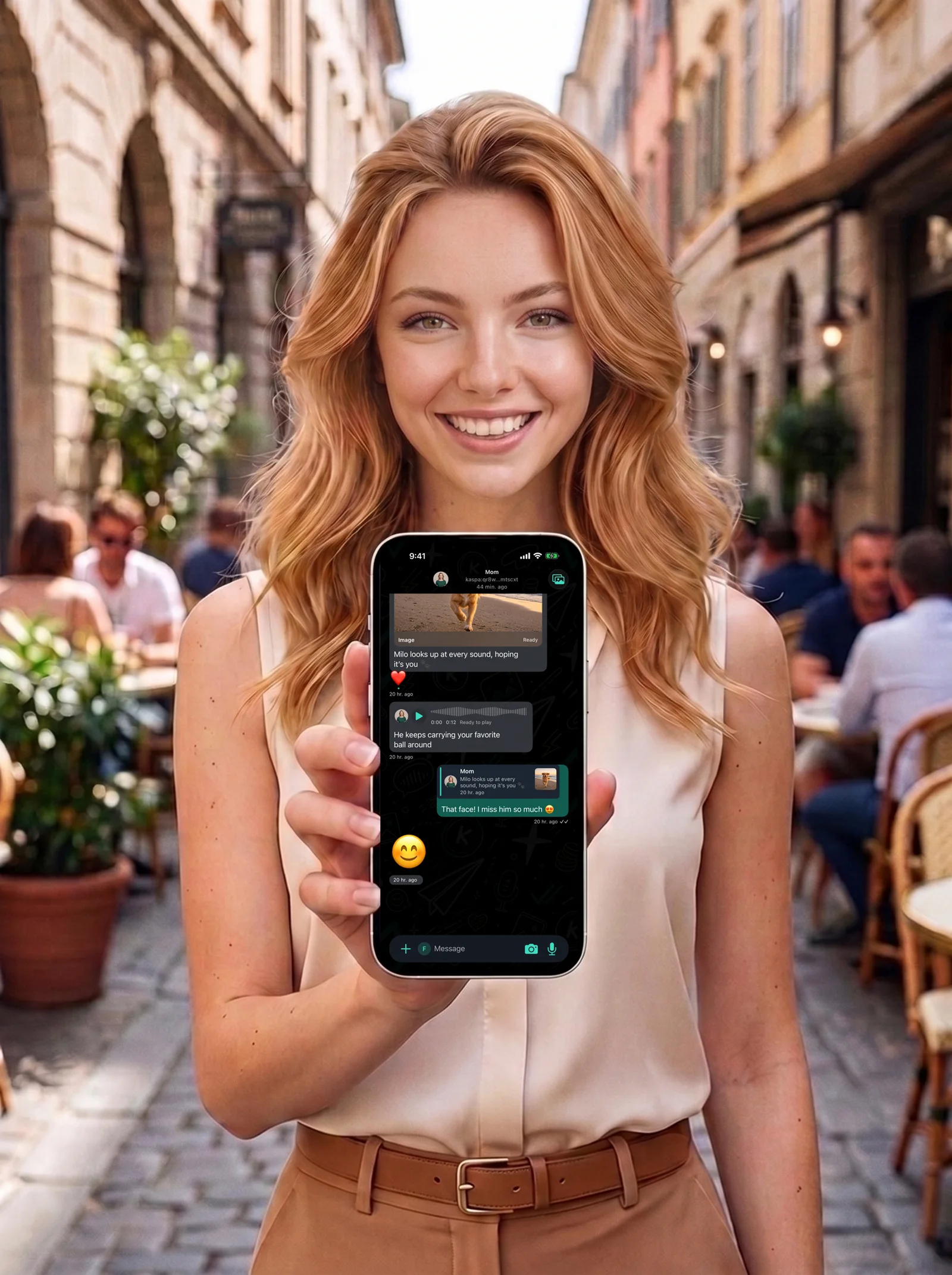
Text, voice, photos, videos and files are encrypted on your device and can be delivered through Fast Push without a KAS balance.
Payments remain optional. KAS becomes relevant only when you deliberately want to pay or use a suitable on-chain proof.

Privacy is not about shutting people out. It is about deciding for yourself who gets access to your life and your conversations.
Theo holds out his phone to Romy. But she never has to reveal a phone number, email address or name. If she chooses, she shares only her KBeam contact. Because KBeam neither uses nor collects those details, the app cannot link them to her cryptographic identity.
Theo approaches Romy in the club and shows her his phone. Only she decides whether it becomes a private contact.
Chat without a phone numberYour KBeam contact needs no phone number, email address or real name.
Your cryptographic identity becomes the contact point. Only you decide who receives it.
Text, voice, images and videos work through Fast Push without buying coins or maintaining a balance.
KBeam does not promise magical invisibility. Instead, the website explains which details are not collected as account data, where encryption takes place and which technical metadata may still arise in a networked app.
Complete anonymity would be too absolute a claim. Optional features involving external processing must be explained separately and deliberately enabled. Reviews and security boundaries are mentioned only when they can actually be substantiated.
KBeam
Google Play remains the official Android channel with automatic updates. If you prefer not to use the Play Store or a Google account, you can alternatively install KBeam directly as an APK.
Official Android channel
Install from the official store and receive future updates automatically.
Get it on Google PlayWithout the Play Store
No Google account is required. Because no store manages this installation, you must download and install future APK updates yourself.
The APK cannot directly replace a Play installation because the signatures differ. Create a complete KBeam backup before switching; uninstalling deletes local data.
Download APK directlyCurrent version 1.1.0 · build 1368 · 51.8 MB · SHA-256
Available since
KBeam requires no Google account and does not use Google Sign-In, Google Maps, Google Pay or Google Play Billing, Play Integrity, or Play Store services. On Android, Google is used only for push notifications through Firebase Cloud Messaging (FCM). Some locally bundled open-source and ML libraries originate from Google projects, but they provide no account, tracking, or store functionality. QR recognition with ML Kit runs locally on the device.
The iPhone version currently remains a TestFlight beta.
KBeam does not collect these details for registration or ordinary private communication. Uploading your address book is not required for the normal invitation flow either. Contacts are created through your deliberate action.
KBeam does not collect a phone number, real name or email address as account data for registration or ordinary private messaging and therefore maps none of them to a wallet address or cryptographic contact. For technical routing, the app knows only the cryptographic identity, not the person behind it, and does not disclose such a personal identity link. Like any networked app, it creates local device data and technically necessary transport metadata. With Wallet V2, the communication identity is intended to be changed or rotated selectively.


Romy captures two small family moments on holiday: her brother Leo, followed by her parents, Vincent and Elena. At first, these pictures belong only on her device. Whether she later shares either of them and who is allowed to see it is her decision alone.
KBeam requires neither a phone number, email address nor real name. The app uses only Romy's cryptographic identity and does not link it to such personal details. When she shares the photo, the image file itself is not transferred as part of the chat message.
Before the photo leaves Romy's device, it is encrypted there. Neither a storage provider nor the transport path receives the image in plain text.
If Romy has configured her own data server, the encrypted file is made available there temporarily. Otherwise, KBeam uses encrypted temporary storage. Both paths serve only as an independent transfer box. KBeam's temporary storage is cleared automatically after seven days.
The message does not contain the image. It carries an encrypted envelope with the protected storage location and the required access information. The recipient downloads the file directly from the transfer box and decrypts it only on their own device.
Romy's original remains on her device. After retrieval, the recipient also has a local copy in KBeam. Clearing the transfer box leaves both copies untouched. Romy can share the image again, and the recipient can continue to view the copy already downloaded.
After retrieval, Romy and her chosen contact keep their local copies. Clearing the transfer box removes only the temporary retrieval source. KBeam, storage providers and other third parties receive no readable copy through this transport path.
The EU is debating rules for monitoring private communications, often referred to as chat control. KBeam does not inspect private messages, automatically or manually. Their content is encrypted on the device before it reaches the transport path. Each user remains responsible for the content they send.
Because KBeam does not collect a phone number, real name or email address as account data, it creates no mapping from those identifiers to a wallet address or cryptographic contact. For technical routing, KBeam knows only the cryptographic identity, not the person behind it, and can neither analyze nor disclose a personal identity link it never collected.
Only content you explicitly submit to an optional feature such as translation is processed separately for that specific purpose.
The political and legal situation can change. KBeam therefore does not promise blanket immunity from regulation; it describes the concrete technical design.
Background from the European ParliamentYou do not need to buy coins or maintain a KAS balance to use KBeam as a messenger. Text messages, voice messages, photos, videos and other ordinary messages can be delivered encrypted through Fast Push.
Fast Push changes only the transport route. The message remains wallet-encrypted. Using KAS as payment funds and sending through the Kaspa Chain are optional and available when proof, value transfer or programmable flows are wanted.
Core messenger features do not require a KAS balance.
Text, voice messages, photos, videos and files belong in the same conversation. You do not need a KAS balance for these ordinary messenger features.
How Fast Push, Kaspa Chain and V2 work
Record personal voice messages directly in the chat and share moments that need more than text.

Romy captures Liv's laughter and then shares the moment where it belongs: in their private conversation.

Share videos directly with your contacts. Private media is encrypted on your device before transport.
Share documents and other files where you already talk. Available sizes depend on the app version and transport route.

Romy, Liv, Nora and Theo laugh, talk, plan and share. KBeam keeps private communication personal without using a phone number, email address or real name as the account anchor.
Everything below is for people who want to go deeper. It remains clearly separated from the current product scope.
Guiding principle
The complete vision explains the role Kaspa plays and why ordinary private communication still requires no KAS balance.
Read the guiding principleIn development
These areas show the development direction. They are separated from the messenger features available today and are not presented as finished.
Open the Wallet V2 outlookFor developers
Auth Gateway has a working demo and a source-available reference on GitHub. The extended customer layer remains an outlook.
Explore Auth GatewayKBeam gives people control of their digital identity and private data again. The Kaspa wallet provides the cryptographic foundation without forcing every message and every action onto the public BlockDAG.
No phone number, forced email, or real name as a requirement. Identity is built from keys, ownership, and mathematical proof.
KBeam is meant to reach people without a wallet, coins, or prior crypto knowledge. Private communication should not feel like a technical specialist project.
The BlockDAG is strong for proof, value, and programmable logic. Fast encrypted transport is strong for private communication. KBeam uses each where it makes sense.
Cryptography should empower people, not make entry harder.
KBeam deliberately separates identity, encryption, authentication, payment capability, and transport. The wallet remains the foundation for identity, trust, KBeam Auth, and decryption. Transport stays flexible.
KBeam is for people who do not want their communication permanently analyzed, tracked, linked, or commercially exploited.
KBeam combines KAS-based identity, private communication, KBeam Auth and strong encryption without forcing every piece of content onto the BlockDAG.
KAS, proof of work and the BlockDAG in simple terms
Kaspa is an open proof-of-work network. Its native coin is KAS. Like Bitcoin, Kaspa is based on proof of work, open participation and no central issuer. The difference is the structure: Bitcoin uses a linear blockchain, Kaspa uses the BlockDAG.
In the BlockDAG, several blocks can be created in parallel and ordered together by GHOSTDAG. This enables very fast confirmations without giving up the proof-of-work idea.
Kaspa was fair-launched: no premine, no hidden allocation, no ICO. KBeam builds on this foundation because a KAS wallet can enable not only payments, but also cryptographic identity.
More information about Kaspa is available on the official website: kaspa.org
KAS-based identity without forcing everything onto the BlockDAG
KBeam is not a messenger that forces every message and every action onto the BlockDAG. The vision is different: users should be able to control their digital identity and private data themselves again.
KBeam is explicitly not only for people who already know crypto. A central goal is to reach users who previously had no wallet, no coins and no connection to cryptographic systems. KBeam should be a simple bridge into the Kaspa world: private everyday communication, carried by KAS-based identity, without the start feeling like a technical crypto project.
That is why KBeam avoids classic identity anchors such as phone number, forced email or real name. Instead, the Kaspa/KAS wallet forms the cryptographic foundation: an identity made not of personal data, but of keys, ownership and mathematical proof.
Cryptography should strengthen people. It is one of the most important technologies against censorship, control and personal repression. At the same time, the entry must not be unnecessarily hard. Users should be able to use private, KAS-based communication without first buying coins or understanding complex wallet processes.
The BlockDAG remains an important part of KBeam. It enables encrypted messages and information, payments, proofs, instructions, programmable flows and later more complex conditions or decisions with Toccata. But not every process has to live on public infrastructure. Private communication is often better served by a fast encrypted transport path, while the BlockDAG is strongest where proof, value transfer, durable availability or programmable logic matter.
KBeam therefore separates identity, encryption, authentication, payment capability and transport. The wallet remains the foundation for identity, trust, KBeam Auth and decryption. Transport can stay flexible: through the BlockDAG when proof, value transfer, logic or planned automated processes matter, or through Fast Push when it is better for fast encrypted delivery and lightweight free messages.
KBeam is for people who do not want their communication permanently analyzed, tracked, linked or commercially exploited.
In short: KBeam uses KAS not as a barrier, but as a key. The BlockDAG is not an end in itself, but a strong foundation for identity, proof, KBeam Auth, payments and programmable possibilities.
Two communication modes in one chat: fast encrypted messaging without mandatory KAS and Kaspa Chain where a transaction is deliberately wanted.
KBeam Fast Push is a custom-built messaging architecture with end-to-end encrypted message payloads. Payloads are encrypted for the recipient using Kasia ECIES (kasia-ecies-hex-v1), while the limited transport metadata required for routing remains separate. Kaspa wallet Schnorr signatures authenticate identities, device routes and authorized operations. Encryption protects the message content, while wallet signatures prove who is authorized to act.
KBeam combines two communication modes inside the same 1:1 chat. For a quick hello or a short conversation, users do not need KAS, spendable wallet funds or a Kaspa transaction. Fast Push provides immediate encrypted communication without putting every small message on-chain.
Whenever users want transaction-backed communication, they can switch from Fast Push to Kaspa Chain directly inside the chat. With sufficient spendable KAS, KBeam can use real Kaspa transactions for encrypted 1:1 messaging, payments and other wallet-native interactions. Automatic mode selects Kaspa Chain when sufficient spendable funds are available and uses Fast Push when they are not.
Fast encrypted everyday communication without requiring a KAS balance or a Kaspa transaction.
Optional for transaction-backed messages, payments, proofs and wallet-native interactions.
Selects Kaspa Chain when sufficient spendable funds are available and otherwise uses Fast Push.
This hybrid model offers both accessibility and choice: fast encrypted communication without mandatory transaction fees, combined with the option to use Kaspa’s UTXO-based network whenever an on-chain interaction is desired.
KBeam V2 is currently being built around a UTXO-native HD-wallet, privacy and identity architecture. It introduces separated accounts for communication, everyday payments, savings and protected funds. Its foundations include rotating communication identities, fresh receive and change addresses, signed Payment Requests, Privacy Clusters, Coin Control, Safe Send, locally aggregated balances and KIP-5 Ownership Proofs.
Coin Control is designed to prevent UTXOs from unrelated privacy domains from being combined automatically. Communication, payment, savings, recovery and legacy funds remain separated by default. Fresh change addresses and conservative, cluster-aware coin selection reduce unnecessary address reuse and avoidable on-chain linkage.
The TOCCATA foundation of KBeam V2 includes Transaction v1, compute_budget, storage-mass accounting, Covenant Bindings, Covenant IDs and a reproducibly pinned Silverscript toolchain. The roadmap extends these foundations into stateful Covenants and Protected Funds, including recipient-locked payments, scheduled payments, allowlist vaults, savings timelocks and inactivity-based recovery mechanisms such as a Dead Man’s Switch.
These V2 capabilities are under active development and remain protected by disabled-by-default feature gates. Mainnet Covenant execution, funded Protected Funds and the Dead Man’s Switch are not yet publicly released. They will require dedicated testing, independent security review and controlled activation.
The goal is to make Kaspa useful for much more than payments: encrypted communication, digital identity, private payment workflows, verifiable ownership and programmable protection of funds—without requiring a blockchain transaction for every short conversation.
A public, source-available reference implementation of the KBeam wallet-authentication model is available on GitHub: kbeam-auth-gateway
Content is protected before servers, push and transport paths see it
KBeam protects content before it reaches servers, push services or transport paths. The app separates identity, content, transport, authentication and storage.
Messages are encrypted with KBeam/KASIA based on wallet keys. Technically, KBeam uses KASIA/ECIES with secp256k1, ECDH, HKDF-SHA256 and ChaCha20-Poly1305.
In simple terms: a shared secret is derived from the recipient's public key and a temporary key. From that, the key is created that encrypts and authenticates the message. Only the matching recipient can decrypt it.
Images, videos, voice messages, PDFs and other files are additionally encrypted per file. KBeam creates a dedicated 32-byte file key and encrypts the file content with AES-GCM.
Only the encrypted file blob made of nonce, ciphertext and auth tag is stored or transferred. The file key is protected inside the encrypted KBeam message envelope and sent to the recipient.
For content that is not plain text messages, the user can configure their own data server, for example their own SFTP server. Files and media are then stored there encrypted. The server stores only the encrypted blob and cannot read the content in plain text.
KBeam Auth uses the wallet as cryptographic proof of identity. The user can approve logins or permissions with the wallet, without requiring a password, email address or central account. A service can verify that the user belongs to their identity without receiving unnecessary personal data.
Private keys and seed phrases are not stored in the normal app database. They are stored in the protected key area of the device, on iOS in the Keychain. The wallet remains the foundation for identity, signatures, KBeam Auth and decryption.
Push is not a place for confidential content in KBeam. Push is a wake signal or transport hint. Standard push systems are transport-protected, but not automatically end-to-end encrypted. That is why KBeam encrypts content itself before it touches push, brokers or servers.
Chats, contacts, groups, outbox, read state and similar app data primarily stay local on the device. Backups or sync paths should not contain more plain text than necessary and are handled separately from wallet secrets.
KBeam Groups are also encrypted. Group content is encrypted before transmission and is not stored on the server in plain text. The server processes only encrypted group events and technical metadata for delivery, synchronization and membership management.
For private groups, the app creates a dedicated group key on the device. New members receive this key not openly through the server, but through encrypted KBeam transport paths to their cryptographic identity. The server transports these data, but does not possess the group key of private groups in plain text and therefore cannot read private group content.
Public groups are intentionally public spaces. Anyone who joins a public group or has access to the public group link can read the content. Even so, public group content is encrypted before transmission and is not stored on the server as plain text.
In short: KBeam protects not only the transport, but the content itself. Servers should be able to deliver, store, wake or forward auth requests, but should not know private messages, media, group keys or file keys in plain text.
Everyone has things that are not meant for everyone: contacts, payments, savings and access to their own wallet. Some family treasures are brought out only in private. Others are deliberately shown to one trusted person. But permission to see one compartment never means access to everything else. Wallet V2 translates this principle into technology: one secret seed remains the shared foundation, while communication, payments, savings and recovery receive separate compartments. The complete picture is brought together only locally on Elena's device.
This V2 outlook is not yet released for production. The features remain behind feature gates that are off by default until testing, security review and controlled activation are complete.

This compartment is intended to contain your KBeam contact identity for chats, profile and groups. Receiving your contact identity does not give anyone access to payments, savings or recovery.
Payments are intended to use separate receive and change addresses. Knowing a payment address does not reveal your chats or automatically expose your savings.
Savings are intended to remain in their own compartment, like a private family treasure. A contact or payment partner does not gain access simply because you share something else with them.
Recovery access is intended to be brought out only when it is truly needed. Chats, contacts and ordinary payments should not expose this especially sensitive compartment.
A communication identity is intended to be renewed selectively. Only chosen contacts receive the new mapping end-to-end encrypted, while the previous route remains reachable during a transition period.
Contact identity and payment funds are being separated technically. A contact should not be able to derive the total balance or savings, change, and recovery addresses from the visible communication address.
Payment requests are intended to use signed one-time addresses and payments fresh change addresses. Local coin control is intended to prevent separate privacy compartments from being merged unnoticed.
Visitors can unlock a protected area with KBeam. The website creates the session, while KBeam only approves the short-lived login challenge.
Responsibility stays clear: KBeam does not know the protected content, and the website keeps roles, permissions, sessions and customer data under its own control.
Live QR login: self-hostable, reviewable and ready to integrate into protected areas.
The first stage is intentionally simple: transparent login without passwords. The next stage is intended to add an optional customer layer that can connect support, contact and product-related workflows.
A wallet address could later be connected to a customer account. The website keeps roles, permissions, sessions and data under its own control.
After login, users could choose to be reachable for support, follow-up questions or direct chat.
KBeam only approves the login challenge. KBeam does not know the protected content of the website that embeds it.
KBeam supports NFC payment flows. A future public integration solution is planned so operators can later connect these payments to their own workflows in a transparent way.
This is an outlook: the website does not claim a finished public NFC API today, but shows the development direction.
KBeam combines cryptographic identity and self-custody with practical private communication. Kaspa is used for optional payments, signatures and selected proofs, not as public storage for every chat.
How Fast Push, Kaspa Chain and V2 workYour wallet forms the cryptographic identity anchor. KBeam collects no phone number, real name or email address as account data for it and therefore creates no mapping from those identifiers to your wallet or cryptographic contact.
KAS payments can be sent directly from the self-custodied wallet. You do not need a KAS balance for text, voice, photos or other ordinary messages.
Cryptographic signatures can confirm identity, payment requests and selected proofs without making private chat content public.
Kaspa's proof-of-work BlockDAG currently runs at ten blocks per second. Optional on-chain payments and proofs benefit from it.
Fast Push transports ordinary messages in encrypted form without automatically writing them to the public BlockDAG. The Kaspa path remains optional for suitable use cases.
Separate contact and payment compartments, fresh addresses and selective rotation are intended to strengthen practical unlinkability. These features are not yet released for production.